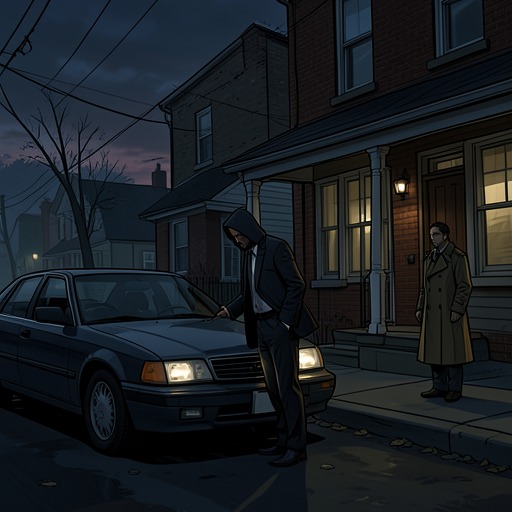
Pete Vitale
I Heard You Paint HousesPete Vitale is presented as an aging Detroit underworld figure whose meatpacking plant and industrial incinerator suggest a means of disposing of a body, but whose actual role in Jimmy Hoffa’s disappearance remains uncertain. In Frank Sheeran’s account, Vitale is at once a possible link in the aftermath of the killing and a personal antagonist, remembered for a veiled threat and a brief, dangerous exchange with Sheeran.
Identity and Detroit Connections
Sheeran identifies Vitale as an uncouth old-timer from Detroit’s Purple Gang. Vitale owned a meatpacking plant, where a body could be cut up, and an industrial incinerator, where one could be burned. Those specific facilities make him relevant to Sheeran’s recollections of what might have happened after Hoffa was killed, but ownership alone does not establish that either place was used.
The connection enters the account through Russell Bufalino’s explanation of what happened to Salvatore Briguglio after the meeting at the house. Bufalino told Sheeran that Chuckie O’Brien dropped Briguglio off at Vitale’s office. Sheeran distinguishes this information from what Briguglio himself could have known: Briguglio had left in the car before Hoffa entered the house, and, in Sheeran’s telling, anything he claimed to know beyond that point was hearsay. Vitale’s office therefore appears in the account as a destination in the chain of movements, not as proof that Vitale participated in the killing.
Threat on Forty-fifth Street
Months later, after Sheeran and Bufalino left Vesuvio Restaurant, they walked down Forty-fifth Street toward Johnny’s and encountered Vitale coming the other way, headed to meet Tony Provenzano. Vitale knew Sheeran disliked him and believed Sheeran mocked his stammer. He stopped, took time to speak without stammering, and told Sheeran, “If it was up to me, the next time I see you and your friend is the next snowstorm in Detroit.”
Sheeran understood the threat through its image of a Detroit snowstorm: in the days when coal was widely used, ashes were spread beneath tires for traction. He laughed at Vitale’s tough talk, deliberately stammered, and answered, “L-L-Like I just told your midget friend. That works both ways. Everybody bleeds.” Bufalino ordered them to stop. The exchange gives Vitale a distinct presence in the narrative: he is not merely an owner of facilities associated with bodily destruction, but a man willing to voice a threat directly to Sheeran.
The Incinerator and the Limits of the Account
Walking away, Sheeran said, “Like you said, ‘Dust to dust,’” thinking of Vitale’s industrial incinerator in Detroit. Bufalino replied that the incinerator was too obvious and would be the first place investigators looked. He said Hoffa had instead been cremated at a Detroit funeral parlor used by people close to the Detroit outfit. Sheeran recalled reading that the FBI had checked Anthony Bagnasco’s funeral parlor in Grosse Pointe Shores because Detroit figures used it.
Sheeran does not settle whether Bufalino’s funeral-parlor account was true or intended to divert suspicion from Vitale’s incinerator. He speculates that a funeral home might have handled the body and perhaps transferred it to a crematorium, but explicitly says he does not know. He also marks the boundary of his claimed knowledge: this detail was not his business, and, in his account, only a cleaner who was still alive could know more. Vitale’s incinerator thus remains a suggestive possibility in Sheeran’s story, not a confirmed site of Hoffa’s disposal.